





Eye For Film >> Movies >> White Man Walking (2025) Film Review



When people talk about wanting to heal the divide in US politics, what they usually mean is that they think minoritised groups should be ‘reasonable’ and give up some of their rights to make those who dislike them feel comfortable – and then, if that doesn’t work, maybe give up a few more. It’s easier to approach it that way round, even for someone who is genuinely trying to be neutral, because at worst people on that side will be offended and say some mean things to you online. Who wants to ask the angry people with guns to give up ground? Rob Bliss wants to try something else.
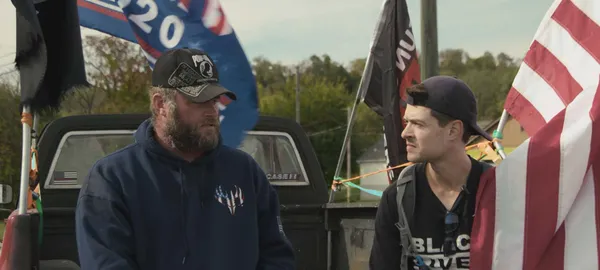
It might be seen as sheer provocation, not unlike some of what we see in the Borat films – a brave (or foolhardy) filmmaker putting his life on the line in order to incite outrage for the sake of entertaining an audience. There is, however, a lot more going on here. When Rob sets out from the Civil Rights museum in Jackson, Mississippi, having set himself the goal of walking the 1,500 miles to Washington DC in time for the 2020 election – the Black Lives Matter t-shirt he will wear throughout is not intended to start fights, but to start conversations. Each bitchy comment, each hostile glance, is followed up by an invitation to discuss the thinking behind it. This way, he hopes, he can change a few minds.

Much of the really ugly stuff is dispensed with quickly at the start. We hear every clichéd response, a great weight of casual racism, and most of it from people absolutely convinced that they’re the reasonable ones, even if they can’t explain why. We also hear an answering machine message from his worried mum. He too is nervous at the outset, still figuring out how best to respond, but he doesn’t doubt his purpose or the usefulness of his mission. Walking past a fence which bears the slogan ‘build the wall’, he reaffirms his commitment. On his back is a sign saying ‘walk with me,’ and it doesn’t take him long to realise that most people who make threats will back away quickly if invited to do so. Most people. In due course – and on more than one occasion – he is threatened with guns.
There is a flip side to this. As he passes through Georgia, a white woman stops him to thank him for his effort and tell him that she thinks the world of him. Most (but not all) of the Black people he meets are supportive, and thank him for using his white privilege to do something that would very likely get them killed. It becomes apparent, however, that some of that privilege, at least in the immediate term, is cancelled out by the t-shirt. He learns to take Black people’s advice about neighbourhoods to avoid and the places where he ought to be extra careful. He begins, to an extent, to experience the world as they do, something that is impossible to achieve through imagination alone. Of course, the big difference is that, sooner or later, he will take off the t-shirt and go back to living a much safer life.
Although he takes heed of advice, there are times when Rob finds himself in risky places, some of which are likely to shock those unfamiliar with this part of the world. The pride that seemingly ordinary people take in extreme right-wing views is matched by the bizarreness of the souvenirs and memorabilia available in shops which openly celebrate the Ku Klux Klan and the German Nazi Party. Still, the shopkeeper in one of these places is happy to chat, saying that he’s just meeting market demand. It’s clear that amorality, or simple disinterest, plays a crucial role in facilitating some of the worst of what Rob sees.
Are there conversations that make a positive difference? Almost certainly – and the interesting thing is that some of them also prove challenging to Rob, making him realise that the assumptions he makes about the intersections of political choice and social philosophy may not always be correct. He also has to contend with the raw emotion underlying some of the hostile behaviour he encounters - not just hatred but also fear. Some people have bought so heavily into the idea that Antifa is an organised group with a dangerous agenda and a plan to kill white Americans that the mere presence of somebody wearing a t-shirt like him makes them think they’re about to be murdered. It’s a deeply paranoid, self-harming perspective which can only exist due to constant reinforcement from other community members, television and provocateurs.
On top of all of this, there is the walking itself. 25 miles per day over 60 days is a perfectly good plan for someone who is properly trained. Rob is not. He does well, all things considered, but learns that fitness is not enough – that feet need to be pre-calloused to handle that kind of strain. Of course, following his public commitment, and in light of how much he’s already done, he feels unable to give up. Here, too, his weaknesses are as visible as anyone else’s. The film is more interesting as a consequence. It may be linear in form, but it’s three dimensional in scope.
Nerve-racking in places, gently comic in others, White Man Walking highlights the diverse ways of thinking that are missed when the country is described as being split in two. It doesn’t hide the horrors, and makes no apology for them, but it also finds warmth and kindness in unexpected places. Rob is not the only person who thinks that conversation – real conversation, with no prior obligation to surrender – makes a difference. As one man who surprises him by walking with him puts it, “We all got to get along, don’t we?”
Reviewed on: 02 Feb 2026


Festivals:
Search database:
